Alius
  • Home
  • About
  • Team
  • Bulletin
  • Journal Clubs
  • Events
    • ASSC Satellite >
      • Attendees
      • Travel Information
      • Program Information
      • Music
  • Membership

Events


ASSC Satellite


ASSC Satellite Event  on
​Non-Ordinary States of Consciousness

Registration fee: 500€
Picture

Picture
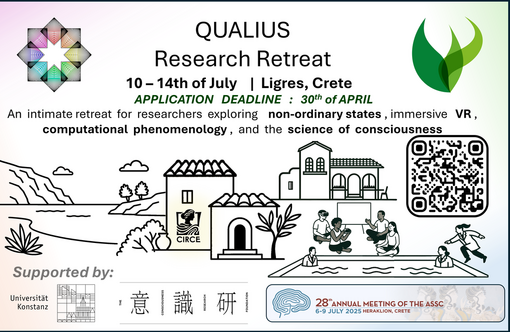
This post-ASSC 2025 satellite event will serve as an interdisciplinary workshop retreat to advance research on consciousness, altered states, and computational phenomenology. It will integrate perspectives from neuroscience, VR, computational modeling, and philosophy, fostering collaboration among researchers with a shared interest in non-ordinary conscious states. A key focus will be on the measurement of subjective effects in altered states research, exploring innovative experiential approaches using VR to induce and study these phenomena. The workshop will also highlight neurophenomenological methods that bridge first-person experience with third-person data, particularly at the intersections of art and neuroscience. Through focused discussions, cross-disciplinary talks, and collaborative sessions, participants will explore formal models of consciousness, including mathematical frameworks and neural modeling approaches. The workshop aims to establish a long-term research consortium, promoting sustainable partnerships and open collaboration to bridge empirical and theoretical perspectives in the study of altered states.

The retreat is designed as a smaller, more intimate gathering of around 35 researchers with a shared interest in altered states of consciousness. Unlike the main conference, which primarily focuses on published work, this retreat will emphasize ongoing and future research, fostering discussions that lead to new collaborations. The aim is to create a space where researchers can connect organically, exchange ideas, and explore potential synergies—whether intellectual, financial, or infrastructural—through a bottom-up approach driven by participant interactions and shared interests.
This approach also informs our selection criteria. Rather than prioritizing traditional academic achievements, we focus on whether applicants’ research interests, ongoing projects, and ambitions align with the retreat’s thematic tracks and contribute meaningfully to productive and interdisciplinary collaboration.

The registration fee of €500 covers accommodation, workshop amenities, catering, and limited travel assistance, ensuring a supportive environment conducive to focused academic exchang​


ASSC 2025 Conference
10 - 14 July
Ligres Crete

Qualius Retreat Participants

Click any participant to explore their biography and research focus. Watch the enhanced particle trails and brighter glows that appear when nodes come into proximity across the 4 orbital layers.
  1. ASSC Satellite
  2. Program
  3. Attendees
  4. Travel
  5. Music


Track 1. Measuring Subjective Effects of Altered States

​This track explores open-science methods for systematically capturing and comparing subjective experiences in altered states, using validated psychometric questionnaires and large-scale data-sharing platforms. It emphasizes refining altered-state taxonomies, improving reliability via dose-response analyses, and integrating quantitative approaches with phenomenological insights to evaluate subjective alterations from various induction techniques. ​Organized by Timo Torsten Schmidt and Cyril Costines.
Experience of Unity
Spiritual Experience
Blissful State
Timo Torsten Schmidt
Cyril Costines


Track 2. Virtual Reality approaches to study Altered States

This track explores state-of-the-art VR approaches for inducing altered states of consciousness (ASCs) by disrupting multisensory integration, altering self-representation, and simulating complex perceptual distortions. It will feature demonstrations of systems such as the Hallucination Machine and the bioresponsive Viscereality Project, facilitating discussions on phenomenological insights and the effectiveness of VR in evoking ASCs. Organized by Keisuke Suzuki, Pawel Motyka, and George Fejer


Track 3. Lived Experiences

This track examines how lived experience, experiential methods, and personal immersion in practices such as breathwork and meditation can enrich academic investigations of consciousness. Through guided sessions and open dialogue, participants will explore integrating introspective perspectives into empirical work, bridging qualitative approaches with cognitive sciences, and reflecting on how personal experience shapes research design. Organizers: Matthias "Mathiós" Braeunig.


Track 4.   Formalizing a Non-Ordinary State Space
curated by the Qualia Research Institute

This track explores computational and phenomenological frameworks for visualizing structural and dynamic dimensions of consciousness, highlighting tools designed to replicate psychedelic visual effects. Demonstrations of QRI's technologies—including their computational toolbox for modeling experiential properties—will illustrate how core theories such as Valence Structuralism and the Coupling Kernels paradigm can help map non-ordinary states, offering insights into subjective experience and human well-being.
​Organized by the Qualia Research Institute and Andrés Gómez Emilsson.
Dynamic Coupling Kernel Animation (Responsive & Transparent)
Coupling Kernel
Picture


Travel Information

Picture
The workshop will take place at Vrachos Villa, a serene retreat in Crete offering a spacious and comfortable environment for in-depth discussions and collaboration. The villa provides accommodation for up to 31 participants, with additional lodging available in nearby hotels for those requiring alternative arrangements. Transport to and from the venue will be organized, ensuring smooth arrival and departure logistics. Participants are expected to arrive on the  July 10th, and departures will be coordinated for July 14th, with assistance available for transfers to the nearest transport hubs.

Place: Agia Paraskevi, Crete   |   https://www.vrachos.gr/​
​Date: 10th - 14th of July, 2025

Main Participants Track 1 Track 2 Track 3 Track 4 Location Travel Information

Your Page Title

Program Information


Arrival Day 1 Day 2 Day 3 Departure
Picture

Thursday, July 10, 2025 - Arrival Day

10:00
onwards
10:00 onwards
Arrival & Check-in
Participants arrive throughout the day. Check-in to accommodations, settle in, meet fellow attendees, and enjoy relaxing time at the beach.
Logistics
Check-in
18:00
Open
18:00 onwards
Listen, Gather, Begin
We meet beneath the night sky to listen, connect, and begin our journey together. Music by Amiruz & Stratos from 19:00
• Echoes Beneath the Stars
  Stratos Bichakis
  Greek Ethno Music Location Recordings (1930–1988) – DJ Set
Stratos Bichakis
• Neo After Dark
  Amiruz
  Greek tunes and beyond…
Amiruz
Beach Party
Beach Evening

Friday, July 11, 2025

07:00
1h 30min
07:00 - 08:30
Morning Glory
Matthias Bräuning
Morning meditations and yoga
Lived Experience
Morning Glory
09:30
1h
09:30 - 10:30
Breakfast
Communal breakfast
Logistics
Breakfast
10:30
1h
10:30 - 11:30
Keynote: Systematic Quantification of Altered States
Timo Torsten Schmidt
The systematic quantification of altered states experiences: achievements and challenges
Track 1 - Measurement
Timo Torsten Schmidt
11:30
20min
11:30 - 11:50
Refining the outer realms: micro-phenomenology and non-ordinary states
James Sanders
First- and third-person perspectives on mind / brain are known to mutually constrain each other, and combining these perspectives (neurophenomenology) is argued to create superior empirical models. Micro-phenomenology (MP) is a formal method of phenomenological interviewing & analysis, developed to address the lack of rigour in first person approaches. This talk describes the anatomy of a typical micro-phenomenological interview, before introducing multiple MP studies from Imperial College London's DMT Research Group.
Track 1 - Measurement
James Sanders
11:50
20min
11:50 - 12:10
A Dissimilarity-Based Bottom-Up Approach for State-Space Mapping
Paweł Motyka
This talk explores consciousness states as configurations of hierarchically nested "qualia sub-spaces" that range from basic sensations to complex constructs like body ownership. The presentation covers how subjective dissimilarity ratings between pharmacologically induced states can be used with dimensionality-reduction techniques to construct state-space from the bottom up. This assumption-free approach may help bridge the gap between what questionnaires can capture and what remains too immersive to articulate.
Track 1 - Measurement
Pawel Motyka
12:10
50min
12:10 - 13:00
Keynote: Altered States Lab Methods
Vince Polito
Comprehensive overview of altered states research methods, psychometric approaches, and clinical applications
Track 1 - Measurement
Vince Polito
13:00
1h
13:00 - 14:00
Lunch
Communal lunch
Logistics
Lunch
14:00
3h
14:00 - 17:00
Siesta
Rest, informal discussions, optional activities, and self-organized spontaneous pop-up breakout sessions
Break
Siesta
17:00
20min
17:00 - 17:20
Hallucination Machine 2.0
Keisuke Suzuki
New directions for the study of visual hallucinations using VR technology
Track 2 - VR
Keisuke Suzuki
17:20
20min
17:20 - 17:40
Sensory-Driven Altered States & New Hallucination Machine Studies
Paweł Motyka
This presentation examines how unusual sensory stimulation can reshape conscious states using adapted versions of the Hallucination Machine. The talk covers developing stereoscopic variants and gaze-coupled modes where visual alterations unfold around the viewer's point of fixation. Results will be presented on effects on subjective experience using questionnaires and verbal descriptions, as well as peripheral physiology including oculomotor behavior and electrocardiography.
Track 2 - VR
Pawel Motyka
17:40
20min
17:40 - 18:00
Viscereality: Bio-responsive VR System
George Fejer
Breath-based interactions with coupled oscillator dynamics to induce non-ordinary states
Track 2 - VR
George Fejer
18:00
20min
18:00 - 18:20
VR and Psychoplastogens
Hector Taylor
Potentially augmented VR treatments for chronic conditions
Track 2 - VR
Hector Taylor
18:20
20min
18:20 - 18:40
Goofi-Pipe Demo
Antoine Bellemare & Philipp Thölke
Accessible biofeedback framework for VR/visual applications
Track 2 - VR
Goofi-Pipe Demo
Antoine Bellemare Philipp Thölke
18:40
20min
18:40 - 19:00
Psychedelic Replications
Raymond (Symmetric Vision)
Ideas and approaches to psychedelic visual replications
Track 2 - VR
Raimonds Jermarks
19:00
30min
19:00 - 19:30
Towards Uncertainty
Yutaka Makino
In my art practice, I critically examine the "reality" we often take for granted, questioning the assumptions embedded within habitual ways of perceiving while embracing uncertainty and foregrounding individual differences in perception. To that end, I integrate scientific insights, artistic experimentation, and technological mediation to foster integrative knowledge production. Note: Wear swim trunks! After the talk there will be a sound performance in the pool!
Track 2 - VR
Yutaka Makino
19:30
30min
19:30 - 20:00
CONFABULATION
Yutaka Makino
In psychology, confabulation typically refers to a phenomenon where a person involuntarily fabricates memories and experiences that never took place. In machine learning, confabulation occurs when a machine learning program generates outputs that are incorrect or nonsensical. This unique composition was performed by 4 speakers laid out around the swimming pool, creating an immersive sonic environment. Participants were able to experience this extraordinary artwork, only ever performed in this context in this manner at our retreat, as part of a deconstruction of the ordinary.
Sound Art Pool Performance
CONFABULATION
20:00
1h 30min
20:00 - 21:30
Dinner
Communal dinner
Social
Dinner
21:30
Open
21:30 onwards
Stratoscapes
Stratos Bichakis
Ambient Performance with Cretan Bulgari
Cultural Performance
Ambient Performance Stratos Bichakis


Saturday, July 12, 2025

07:00
1h 30min
07:00 - 08:30
Morning Glory
Matthias Bräuning
Morning meditations and yoga
Lived Experience
Morning Glory
09:30
1h
09:30 - 10:30
Breakfast
Communal breakfast
Logistics
Breakfast
10:30
1h 30min
10:30 - 12:00
Keynote: Parametrizing Psychedelic States of Consciousness with Dynamic Systems and Coupling Dynamics
Andrés Gómez Emilsson
Image-based, visual-based state classifications - opening keynote
Track 4 - QRI
Andrés Gómez Emilsson
12:00
1h
12:00 - 13:00
On the Computational Properties of DMT-Altered Consciousness
June Russell
Exploring the computational frameworks underlying DMT-induced altered states of consciousness
Track 4 - QRI
June Russell - QRI
13:00
1h
13:00 - 14:00
Lunch
Communal lunch
Logistics
Lunch
14:00
3h
14:00 - 17:00
Siesta
Rest, informal discussions, optional activities
Break
Siesta
17:00
30min
17:00 - 17:30
Workshop Opening: Towards a Big-Data Quantitative Phenomenology of Visual Hallucinations
Trevor Hewitt
Training participants to create images of their stroboscopically-induced hallucinations reveals systematic patterns in geometric formations across different light frequencies, opening new pathways for computer-vision analysis of visual experiences.
Track 2 - VR/Visual
Trevor Hewitt
17:30
2h
17:30 - 19:30
Parallel Session A: Phenomenological Playground
Andrés, Taru, Till, Philipp & Antoine
Interactive live coding session - creating visuals with beamer, live audience participation, goofi-pipe and nerdiness
Track 2 - VR/Visual
Phenomenological Playground
Andrés Gómez Emilsson Taru Emilia Hirvonen Till Holzapfel Philipp Thölke Antoine Bellemare
17:30
2h
17:30 - 19:30
Parallel Session B: FOLDINGS
Yutaka Makino
An interdisciplinary art project that challenges ordinary consciousness by distorting spatial perception through custom goggles and audio manipulation. Visitors experience environmental sound normally while their vision is distorted, doubled and tinted pink. As time passes, audition changes - left/right reversed, then delayed, then multiplied - affecting vision until one sees their environment doubled, tripled, quadrupled. The perceptual loop creates adaptation, making even normal surroundings feel different.
Track 2 - VR/Visual
FOLDINGS
19:30
1h 30min
19:30 - 21:00
Aperitivo Beach Sunset
Social drinks and sunset viewing
Social
Aperitivo Beach Sunset
21:00
1h
21:00 - 22:00
Dinner
Communal dinner
Social
Dinner
22:00
Open
22:00 onwards
Weird Together
AS IF
B2B DJ Set
Music
AS IF

Sunday, July 13, 2025

07:00
1h 30min
07:00 - 08:30
Morning Glory
Matthias Bräuning
Morning meditations and yoga
Lived Experience
Morning Glory
09:30
1h
09:30 - 10:30
Breakfast
Communal breakfast
Logistics
Breakfast
10:30
1h 15min
10:30 - 11:45
Special Keynote: Tulpamancy
Michael Lifshitz
Exploring the phenomenon of tulpamancy and its implications for consciousness research
Michael Lifshitz
11:45
1h 15min
11:45 - 13:00
The Great Tulpa Consciousness Debate
June Russell, Andrés Gómez Emilsson, Till Holzapfel & Marc Antonio
Interactive debate exploring the nature of tulpa consciousness and its implications for understanding awareness
Debate
June Russell - QRI Andrés Gómez Emilsson Till Holzapfel Marc Antonio
13:00
1h
13:00 - 14:00
Lunch
Communal lunch
Logistics
Lunch
14:00
3h
14:00 - 17:00
Siesta
Rest, informal discussions, optional activities
Break
Siesta
17:00
1h
17:00 - 18:00
What Kind of Suffering Does Meditation Reduce?
Vismay Agrawal
Meditation has been shown to reduce various forms of suffering and increase well-being. However, its broad effectiveness raises the question: In what way does meditation reduce suffering? We explore this systematically, proposing that meditation's effectiveness stems not from addressing specific types of suffering but from dismantling underlying mechanisms that create the conditions for suffering.
Meditation Research
Vismay Agrawal
18:00
1h 30min
18:00 - 19:30
Super Special Keynote: Introduction to the Psychodynamics of the psychedelic experience
Tobias Buchborn
A comprehensive exploration of the psychodynamic frameworks underlying psychedelic experiences
Super Special Keynote
Tobias Buchborn
19:30
Open
19:30 onwards
Filoxenia
(griechisch: φιλοξενία)
Evgenia Damavoliti-Toli – vocals, percussion
Zacharis Spyridakis – vocals, lyra
Vasilis Bichakis – vocals, laouto
Michalis Kontaxakis – vocals, mandolin
An evening of mezé, raki, and Cretan live music
Cultural Evening
Filoxenia
Evgenia Damavoliti-Toli Zacharis Spyridakis Vasilis Bichakis Michalis Kontaxakis

Attendees


George Fejer Zuri Maria Daiss Stratos Bichakis Timo Torsten Schmidt Cyril Costines Pawel Motyka Keisuke Suzuki Till Holzapfel Andrés Gomez Emilsson Taru Emilia Hirvonen Raimonds Jermaks Alfredo Parra James Sanders Kazuya Horibe Hector Taylor Aline Frick Antoine Bellemare Tobias Buchborn Vince Polito Noah Clark Natalia Santander Philipp Thölke Vismay Agrawal Michael Lifshitz Yutaka Makino Romy Beauté France Lerner Mar Estarellas Trevor Hewitt Chiara Caporuscio Matthias "Mathiós" Braeunig Yann Harel Marc Antonio QRI ALIUS QRI
Event supported by
Qualia Research Institute
Picture

George Fejer | Lead organizer

gfejer-image
George Fejer is a PhD candidate in Cognitive Psychology at the University of Konstanz and a coordinator for the ALIUS research network, specializing in altered states of consciousness. His research focuses on bioresponsive VR interfaces to study breathwork-induced consciousness shifts, particularly the extension of peripersonal space in altered states through the Viscereality project. With a Master’s in Cognitive Neuropsychology, he is currently conducting research at the Max Planck Institute for Brain & Cognitive Sciences, integrating neuroscience and psychology to explore the interplay between embodiment, virtual reality, and consciousness.

Zuri Maria Daiss | Head of Operations, Logistics & Festivities

Picture
Zuri Maria Daiß is a cultural curator, organizer, and strategist in music and the arts, active internationally across festivals, artist management, and public relations. With over 18 years of experience in cultural production, she has worked on experimental music and interdisciplinary projects, specializing in marketing, sponsorship, and strategic partnerships. She is the co-founder of ZURI & MARIA Agency, focusing on artist management, festival curation, and project conception, and has been a partner at Stars & Heroes Communications since 2010, leading international media campaigns for musicians and labels. Her curatorial work spans institutions such as HAU Hebbel am Ufer, the Norient Music Film Festival, and projects like The Only Good System Is a Sound System. A jury member for cultural funding programs, she has contributed to shaping contemporary artistic initiatives across various regions. While much of her work has been based in Europe, she has been involved in numerous international projects, including in Greece.

Timo Torsten Schmidt | Co-Organizer of the Subjective Experience Track

Picture
Dr. Timo Torsten Schmidt is a neuroscientist at Freie Universität Berlin, specializing in experimental consciousness research. He researches neural mechanisms of human consciousness in mental imagery, working memory and altered states of consciousness. With a background in Cognitive Science, Medical Neuroscience, and Computational Neurosicence, he has conducted research at institutions such as the Bernstein Center for Computational Neuroscience Berlin, the University of Osnabrück and the Freie Universität Berlin. He is a co-founder of the Collaboration for Interdisciplinary Research on Conscious Experience (CIRCE), which advances the scientific study of consciousness and altered states by providing high-quality reference datasets and best-practice measurement methods. As advocate for open and citizen science, he is the founder of the Altered States Database, promoting reference data for the research community to promote interdisciplinary research in consciousness studies.

Cyril Costines | Co-Organizer of the Subjective Experience Track

Picture
Cyril Costines is a doctoral researcher at the Medical Center – University of Freiburg, Germany, and the Institute for Frontier Areas of Psychology and Mental Health (IGPP) in Freiburg, Germany. His research focuses on the neurophenomenological study of consciousness as such, with particular emphasis on altered states induced by meditation, psychedelics, and sensory deprivation. As a member of the MPE research network, he works on the theoretical and empirical investigation of pure awareness in the context of "nondual floating." He is a co-founder of the Collaboration for Interdisciplinary Research on Conscious Experience (CIRCE), where he co-initiated the Altered X Project (AXP), dedicated to mapping the phenomenal state-space. He is also co-founder of the Contemplative Lab (ConLab), a citizen science initiative to facilitate dialogue between meditation researchers and meditators on a culture of consciousness.​

Stratos Bichakis | ​Production Assistant

Picture
Stratos Bichakis is a transdisciplinary artist. His work centers on experiential installations and performances that transform human senses through digital technologies. He develops artistic tools and instruments, to explore the emotional and transcendent possibilities of sound, light, motion and language. |    photo credit: Jamie Rosenberg

Marc Antonio | ​Attendee

Picture
Marc Antonio is an AI researcher and philosopher based in Amsterdam. With an academic background in formal logic and transcendental phenomenology, he developed a deep interest in the convergence of biological and artificial neural networks, as well as interdisciplinary approaches to mechanistic interpretability. His research explores cognitive systems, game theory, the homology between qualia space and social space, and the neurophenomenology of tantra. Beyond his theoretical work, Marc engages in creative projects at the intersection of art and technology. He is currently developing an experimental system in which neurofeedback, captured via EEG, dynamically influences the prompt of an autoregressive video model—creating a real-time feedback loop that probes the resonance between human and synthetic systems.

Pawel Motyka | Co-Organizer of  Virtual Reality Track

Picture
Dr. Paweł Motyka is a researcher in psychology specializing in consciousness studies, altered states of consciousness, and multisensory integration. He is currently affiliated with the Institute of Psychology at the Polish Academy of Sciences. His research explores the interplay between interoception and exteroception, time perception, and the role of bodily processes in conscious awareness. He has collaborated with institutions such as the University of Sussex and the Max Planck Institute for Human Cognitive and Brain Sciences. His recent work focuses on altered states of consciousness and cybernetic hallucinations in virtual reality, advancing our understanding of perception and conscious experience.

Keisuke Suzuki | Co-Organizer of  Virtual Reality Track

Picture
Keisuke Suzuki is a cognitive scientist specializing in embodied cognition and conscious presence. He obtained his Ph.D. in artificial life from the University of Tokyo in 2007 and conducted research on human cognition in virtual reality at RIKEN Brain Science Institute (2008–2011). He later joined the Sackler Centre for Consciousness Science at the University of Sussex (2011–2021), where he developed VR-based experiments on self-consciousness. Since 2021, he has been a specially appointed lecturer at Hokkaido University’s CHAIN center. His research combines virtual reality, experimental manipulation of bodily and mental states, and theoretical modeling to investigate the neural mechanisms underlying the subjective sense of presence.

Till Holzapfel | Co-Organizer of  Virtual Reality Track

Picture
Till Holzapfel (aka Mesmer Prism) is a cognitive scientist and digital artist whose work explores the intersection of altered states of consciousness, embodiment, and immersive technologies. Having earned his Master's degree in Cognitive Science from the University of Osnabrück, he served as lab manager for the Intangible Realities Lab under Dr. David Glowacki, where he developed expertise in virtual reality applications. His artistic practice creates prismatic, particle-based immersive experiences that challenge conventional notions of avatar embodiment, while his research with the Viscereality Project investigates how bio-responsive VR applications can adapt to users' breathing patterns to induce altered states of consciousness. His work work showcases  the emerging field of consciousness studies in extended reality contexts.

Picture

Taru Emilia Hirvonen | Attendee

Picture
Taru Hirvonen is a computer science with a strong interest in consciousness research, known for her work developing mathematical models and visualizations to explore the dynamics of conscious experience

Raimonds Jermaks (Symmetric Vision) | Attendee

Picture
Raimonds Jermaks, known as Symmetric Vision, is a Latvian multidisciplinary artist whose work merges digital art, altered states research, and immersive visual storytelling. Since 2014, he has created nearly a thousand intricate visuals that evoke non-ordinary states of consciousness, drawing from meditation, dreams, sensory deprivation, and psychedelics (Psyworldwide). Using tools like After Effects, Blender, and audio software, he translates inner experiences into dynamic, multidimensional environments. Celebrated for his live projection mapping and VJ sets at festivals like MoDem and Shankra, his performances transform physical space into synesthetic landscapes. His concept of “psychedelic cryptography,” where hidden messages become visible only in altered states, earned recognition from the Qualia Research Institute and coverage in VICE. His work has also been acknowledged for visually modeling phenomena like entity encounters and multisensory fusion during psychedelics. Through his YouTube channel, mobile app, and educational content, Jermaks makes complex inner realities accessible, inviting audiences to reimagine the boundaries of perception.

France Lerner | Attendee

Picture
France Lerner holds a B.A. in Fine Art and Art History from Kingston University and a Ph.D. in Art and Science from the Royal Academy of Arts, conducted in collaboration with HELESI at UCLouvain and the COMA Science Group at the University of Liège, under the supervision of Prof. Steven Laureys and Prof. Mylène Botbol-Baum. Her dissertation, Near-Death Experiences States: Matters of Displacement (E-motion, Creation, Reparation), explored altered states of consciousness through embodiment and spatiality. She completed a postdoctoral fellowship at the Weizmann Institute of Science in the Laboratory for Robotics and Virtual Reality under Prof. Tamar Flash and currently serves as Assistant Professor at the Beijing Institute of Mathematical Sciences and Applications (BIMSA), supported by the Beijing Natural Science Foundation (BJNSF). Her current research uses graphic-verbal methodologies to segment near-death experiences (NDEs) into spatio-temporal sequences, revealing patterns of self-location and motion. Alongside her scientific work, she maintains an international artistic practice as a permanent artist at SEE Gallery, where she explores consciousness, time, and space.

Alfredo Parra | Attendee

Picture
Alfredo Parra conducts research and advocacy at the Qualia Research Institute, where he focuses on strategies to quantify and reduce extreme suffering (e.g., from cluster headaches and kidney stones). He has also authored a forthcoming paper on physical ontologies in the Journal of Consciousness Studies. Previously, Alfredo spent seven years in management and operations at two AI risk non-profits—the Center on Long-Term Risk and the Institute for Law & AI—working to mitigate existential threats. He holds a Master’s and PhD in computational science from the Technical University of Munich and a Bachelor’s in engineering physics from Tecnológico de Monterrey. His publications cover topics in numerical mathematics, mathematical optics, and high-performance computing.

Trevor Hewitt | Attendee

Picture
Trevor Hewitt is a PhD candidate in informatics under the prestigious Margaret Boden Scholarship. He is currently conducting research into visual hallucinations using AI and computational neurophenomenology methods under the superivison of Prof. Anil Seth and Dr. David Schwartzman at the Sussex Centre for Consciousness Science. ​

James Sanders | Attendee

Picture
James W. Sanders is a psychologist, cognitive neuroscientist, and phenomenologist at the Centre for Psychedelic Research, Imperial College London. Specializing in the micro-phenomenological method, his research explores acute and extended DMT experiences, 5-MeO-DMT, and advanced meditation states, and he also teaches micro-phenomenology and phenomenological interviewing to researchers and psychedelic integration specialists.

Kazuya Horibe | Attendee

Picture
Kazuya Horibe is currently a Special Postdoctoral Researcher at the RIKEN Center for Brain Science (CBS). He is studying computational biology and artificial life in the graduate school of Osaka University, after finishing his Bachelor’s degree in biological science at Osaka University and his Master’s degree in information science at Osaka University. He received his Ph.D. from Osaka University.

Hector Taylor | Attendee

Picture
Hector Taylor is a dual PhD candidate in Neuroscience and Psychology in the Psychedelic Research group at the Psychiatric University Hospital of Zurich, where he integrates virtual reality embodiment-simulation techniques with psychedelic compounds to develop novel treatments for chronic pain. He holds a B.S. in Cognitive Psychology from Arizona State University and has managed clinical neurology trials in Boston as well as served as Lab Manager at Brown University's Virtual Environment Navigation Lab. His research uses neurophenomenological modeling and functional near-infrared spectroscopy (fNIRS) to link subjective states to cortical dynamics, and he is interested in collaborative projects combining cognitive neuroscience, immersive technology, and altered states.

Aline Frick | Attendee

Picture
Aline Frick completed her research master’s in Cognitive and Clinical Neuroscience at Maastricht University in the Netherlands. She currently works as a Jungian art therapist and research assistant at a precision psychiatry start-up that develops digital tools to personalize mental health care. Her research focuses on altered states of consciousness and their potential to support psychological transformation and emotional regulation. Driven by a particular interest in women’s health within psychedelic therapy, Aline contributes to research at Hystelica, an organization committed to redefining the understanding and treatment of women’s mental health by exploring how hormonal sensitivity and menstrual cycle phases impact the efficacy and safety of psychedelics.

Antoine Bellemare | Attendee

Picture
Antoine Bellemare is a multidisciplinary artist and postdoctoral researcher at Bard College in New York. He earned a PhD in neuroscience and digital arts from Concordia University, where his research explored creativity through electrophysiological signals and algorithmic composition—particularly how sensory noise shapes creative perception and meaning emerges from ambiguous information. Antoine has developed interactive installations that blend biosignals from plants, brains, and hearts to craft new narrative experiences. His work brings together poetry, neuroscience, electroacoustic music, and artificial intelligence as converging modes of expression. You can explore his artistic projects at his personal website: antoinebellemare.com.

Tobias Buchborn | Attendee

Picture
Tobias Buchborn holds a diploma and PhD in Neurobiology from Otto-von-Guericke University Magdeburg, where he studied behavioral and molecular mechanisms of psychedelic tolerance. He has worked at Imperial College London using optogenetic voltage imaging to investigate cortical dynamics during psychedelic states, and is currently at the Central Institute of Mental Health Mannheim (ZI), applying chemogenetic and fiber photometry techniques to explore the therapeutic potential of psychedelics in addiction. Among his current projects, Buchborn’s recent study, "Ego Dissolution and Therapeutic Mechanisms in Psychedelic Therapy", examines how psychedelics induce ego dissolution and how altered self-boundaries may contribute to therapeutic outcomes by integrating neurobiological and psychological perspectives.

Vince Polito | Attendee

Picture
Vince Polito is a Senior Lecturer in the School of Psychological Sciences at Macquarie University, where he investigates how altered states of consciousness impact cognition and mental health. His research spans hypnosis, flow states, meditation, yoga, chanting, virtual reality, religious rituals, and psychosis. Vince is best known for leading Australia’s first longitudinal study of psychedelic microdosing and is developing a psychedelic research program at Macquarie that includes the world’s first MEG (magnetoencephalography) study of microdosing. He is also leading one of Australia’s largest psychedelic clinical trials, the MicroDep Trial, which explores the use of low doses of psilocybin as a potential treatment for depression.

Noah Clark | Attendee

Picture
Noah Clark is an independent researcher and software engineer with over 12 years of experience in architecting and developing software, with a particular passion for graph-based modeling. Motivated by a deep interest in meditation and phenomenology, he founded iAm, a software platform for computational phenomenology that enables real-time measurement and idiographic temporal network modeling of subjective experience. His work centers on developing methods to capture the dynamic, temporal, and interconnected nature of consciousness as it unfolds. Committed to formalizing the measurement and classification of subjective perception, Noah promotes an open-science, collaborative approach to building systematic models of experience. He is eager to engage with fellow researchers to push the boundaries of computational phenomenology through innovative tools and methodologies for studying the mind.

Natalia Santander | Attendee

Picture
Natalia is a multidisciplinary practitioner with roots in Latin America and a current base in Lisbon. Her path has moved between corporate roles in the tech world, long-term spiritual practices, and creative exploration. She holds a Bachelor of Fine Arts and a Master’s in Curatorial Studies from IUNA Buenos Aires, and is currently exploring the intersection of somatic awareness, energy perception, and immersive design. Her work is guided by a deep interest in how subtle experience, aesthetics, and inner practice can inform new forms of healing and human connection.

Philipp Thölke | Attendee

Picture
My research focuses on the intersection of computational neuroscience, real-time neurotechnology, and consciousness studies, with an emphasis on developing computational tools to investigate mental states from a multi-modal perspective. A central project is goofi-pipe, an open-source framework for real-time EEG and biosignal processing that enables intuitive prototyping of low-latency biofeedback systems in embodied, interactive contexts. I apply complexity and criticality frameworks to EEG data to explore brain dynamics across cognitive states, using machine learning to uncover latent patterns and structure in neural activity. This work contributes to the development of AI foundation models that embed neurophysiological data into structured latent spaces for brain decoding and connects to the broader field of computational phenomenology, aiming to relate data-driven insights to the structure of conscious experience. Parallel efforts explore the convergence of neurotechnology and digital art through generative, signal-responsive installations, creating interfaces that engage both analytical and experiential dimensions of mind.

Yann Harel | Attendee

Picture
Yann Harel is a postdoctoral researcher at University of Montreal whose work lies at the intersection of cognitive neuroscience and media technologies, aiming to understand how biological and artificial systems learn, perform and interact. In particular, he leverages neuroimaging, electrophysiology and machine learning in naturalistic videogame paradigms to investigate the neural computations underlying intelligence and consciousness. His interdisciplinary work bridges neuroscience, gaming, and digital arts, examining how digital media shape brain dynamics and influence cognitive processes relevant to mental health. He is committed to open science and knowledge sharing, blending rigorous methodology with creative applications that reimagine how humans and machines learn and play together.

Vismay Agrawal | Attendee

Picture
Vismay Agrawal is pursuing a PhD at the Monash Centre for Consciousness and Contemplative Studies (M3CS), Australia, under the supervision of Prof. Jakob Hohwy, Director of M3CS (research.monash.edu) and Dr. Ruben Laukkonen, Senior Lecturer in cognitive science and computational neuroscience (rubenlaukkonen.com). His primary interests include understanding mental suffering, advanced meditative insights, and phenomenology. His research investigates how meditation reduces suffering by integrating insights from contemplative traditions, psychology, and active inference . Outside academia, Vismay works as a meditation and psychedelic-integration coach, facilitating retreats and guiding individuals on mindfulness journeys. His personal meditation practice follows the MIDL Meditation method developed by Stephen Procter and grounded in traditional Buddhist insight practices.

Matthias "Mathiós" Braeunig | Attendee

Picture
Matthias (as currently living in Greece also called "Mathiós") is an independent research scientist with a background in physics (Dipl.-Phys. from FU Berlin in 1989). Working in the field of Psychosomatic Medicine for most of his academic career, he specializes in medical statistics, Data Science and R programming. Furthermore, his scientific expertise is complemented by decades of contemplative practice, yoga and Tibetan Buddhist meditation, which he teaches to interested students.

Michael Lifshitz | Attendee

Picture
Michael Lifshitz is an Assistant Professor in the Division of Social and Transcultural Psychiatry at McGill University in Montreal. He completed his PhD in neuroscience at McGill and pursued a postdoctoral fellowship in anthropology at Stanford University, where he worked with Tanya Luhrmann to explore how culture shapes spiritual experience. He now co-directs the Psychedelics and Contemplation Lab at McGill, an interdisciplinary research group combining phenomenology, neuroscience, and ethnography to investigate the plasticity of consciousness. His work focuses on practices that aim to transform subjective experience—such as meditation, hypnosis, placebos, prayer, and psychedelics—with a particular interest in how these practices modulate the sense of agency, making thoughts, actions, and sensations feel as if they emerge from a source beyond the self.

Yutaka Makino | Attendee

Picture
Yutaka Makino, born in 1976 in Tochigi, Japan, is an artist and researcher based in Berlin, Germany, and Fukuoka, Japan. Drawing on fields such as psychiatry, psychoacoustics, neuroscience, linguistics, and the history of science, his performances and installations explore perceptual processes through experimental setups. By creating acoustically and visually conditioned environments, his work makes perception itself tangible, inviting reflection on the act of perceiving and on behavioral responses to stimuli. Makino’s work has been presented at institutions and festivals including Akademie der Künste, daadgalerie, Haus der Kulturen der Welt, ZKM | Zentrum für Kunst und Medien, Japan Society New York, Donaueschinger Musiktage, MaerzMusik, CTM Festival, Gaudeamus Muziekweek, Sónar, and Sonic Acts. He has received awards and fellowships from institutions such as Prix Ton Bruynèl, the DAAD Artists-in-Berlin Program, Villa Aurora Los Angeles, MacDowell, the Japanese Agency for Cultural Affairs, and the Pola Art Foundation. He is currently an Associate Professor at the Faculty of Design, Kyushu University.

Chiara Caporuscio | Attendee

Picture
Chiara Caporuscio is a postdoctoral researcher at Charité Universitätsmedizin Berlin and FAU Erlangen. She's working on ethical and epistemic issues in psychedelic research. Her research interests include non-ordinary states of consciousness, delusional beliefs, and disruptions of rationality.

Romy Beauté | Attendee

Picture
Romy Beauté is a PhD candidate at the Sussex Centre for Consciousness Science within the School of Engineering and Informatics at the University of Sussex, investigating altered states of consciousness at the intersection of phenomenology and computational methods under the supervision of Prof. Anil Seth (who co-directs the Centre) (sussex.ac.uk), Dr. Adam Barrett (users.sussex.ac.uk), and Dr. David Schwartzman (profiles.sussex.ac.uk). She’s affiliated with the be.AI – biomimetic embodied AI programme within the Centre for Computational Neuroscience and Robotics (sussex.ac.uk), and is an enrichment student at the Alan Turing Institute. Romy holds an MSc in Cognitive Sciences (Cogmaster) from the École Normale Supérieure, Paris and an MSc in Applied Mathematics and Machine Learning (MVA) from the École Normale Supérieure Paris‑Saclay, where she applied machine learning to detect residual cognition in unresponsive patients and performed multivariate analysis of neural correlates of self-awareness in hypnosis. Her PhD combines natural language processing—developing the MOSAIC framework for clustering phenomenological reports—with neural complexity measures to map relationships between subjective experience and brain dynamics. Beyond her formal program, she is keenly interested in how lived experience and cultural background shape beliefs and ontological perspectives.

Mar Estaralles | Attendee

Picture
Mar Estarellas is a postdoctoral researcher at McGill University, where she studies the interaction between brain, body, and natural rhythms through a transdisciplinary and neurophenomenological lens. In her previous postdoc at the University of Cambridge, she explored brain information profiles across wake–sleep states, with applications to neurodegenerative diseases. Her current research bridges neuroscience, phenomenology, and ecology to understand how perception and synchronization with the environment shape conscious experience. She is particularly interested in how practices like meditation, psychedelics and immersion in nature modulate brain activity and foster a sense of connection to the world. She is committed to re-enchanting scientific research through storytelling, traditional ecological knowledge, and embodied engagement with the natural world.

Andres Gomez Emilson | ​Co-Organizer of the Qualia Research Track

Picture
Andrés Gómez Emilsson is a researcher in consciousness studies and the Director of Research at the Qualia Research Institute (QRI). With a background in Symbolic Systems and Computational Psychology from Stanford University, his work integrates neuroscience, philosophy, and artificial intelligence to explore the computational properties of consciousness. His research focuses on qualia mapping, the pleasure-pain axis, and psychedelic-induced alterations in consciousness, alongside developing neurotechnologies to study and influence subjective experience. He is known for contributions such as the Symmetry Theory of Valence and topological models of consciousness, advancing both theoretical and applied approaches to understanding subjective experience.

Qualia Research Institute | ​Co-Organizational Partner

Picture
The Qualia Research Institute (QRI) is a nonprofit organization based in Silicon Valley, dedicated to developing a mathematical framework for consciousness and understanding emotional valence—why experiences feel good or bad. Founded in 2018 by Andrés Gómez Emilsson, Mike Johnson, and Romeo Stevens, QRI employs a qualia formalist approach, treating subjective experiences as mathematical objects. Its key projects include the Symmetry Theory of Valence (STV), which links pleasure to mathematical symmetry, the Tracer Replication Tool for quantifying altered states, and collaborations with institutions like King’s College London and Imperial College London to study psychedelics and meditation. With a mission to enhance human well-being through neurotechnology and rigorous phenomenology, QRI bridges neuroscience, computational modeling, and philosophy to explore the structure of experience. ​As a funding partner, QRI is co-funding our workshop, supporting research on altered states of consciousness.

ALIUS Research Group | ​Co-Organizational Partner

Picture
The ALIUS Research Group is an international, interdisciplinary collective dedicated to the scientific study of consciousness and altered states of consciousness (ASCs). Founded in 2014, it brings together neuroscientists, psychologists, philosophers, psychiatrists, anthropologists, and computer scientists to explore the diversity of conscious experiences. ALIUS promotes a naturalistic and interdisciplinary approach, integrating ASCs into mainstream research while addressing methodological and theoretical challenges. Its activities include theoretical and experimental studies, the ALIUS Bulletin, and international workshops fostering collaboration among researchers. The group actively supports scientific dialogue and research dissemination, advancing a systematic understanding of ASCs.

Travel Information


Picture

Arrival

Arrival
before
10th of July

The retreat location, Agia Paraskevi in southern Crete, is quite remote and travel in this region can be time-consuming. If you are not already attending the ASSC conference in Heraklion, we strongly recommend booking an extra night before and/or after the retreat in Heraklion or Chania to ensure a relaxed arrival and departure. Both cities are beautiful and well worth exploring while you're here.

Arrival
on
10th of July

If you are not attending the main ASSC conference, you should aim to arrive either at Heraklion or Chania Airport no later than 9:30 AM on the day of arrival.

Airplane
Meeting point
on 10th of July
to get to retreat
Heraklion Bus Stop

There are a limited number of shuttle bus seats available for transportation from Heraklion directly to the venue. Some participants will be traveling by car, and we will aim to create driving communities for shared transportation. We will also organize groups for those using public transport buses. We ask that all participants make provisions to be at the Heraklion Main bus station by 11:00 AM on the day of arrival. Address: Leof. Ikarou 9, Iraklio 713 06, Greece.

Travel itinerary
via
public transport
Travel itinerary map

Departure

Departure
on
14th of July
Airplane

On the departure day, we will provide shuttle services from the retreat to Spili. From there, participants will need to arrange their own transportation to their final destinations.

Buses from Spili with changes in Rethymno will get you to the airports at Heraklion or Chania Airport between 18:00 and 19:00 on July 14th, so please avoid booking outbound flights earlier than 20:00.

Please book your availability accordingly. We recommend either spending a night in Heraklion or Chania or taking the night ferry to Athens as outlined below.

Alternative:
Night Ferry
to Athens
Night Ferry
to Piraeus

For those seeking better or cheaper international connections, you can opt for the night ferry from Heraklion to Piraeus (Athens). These ferries depart from Heraklion in the evening (typically around 21:00) and arrive in Piraeus the following morning around 06:15-06:30. Ferry companies include ANEK Lines and Minoan Lines, with tickets ranging from €41-€52 depending on the service.

Check Available Ferries

Departure
Itinerary
Travel departure options map

Taxi
Numbers
Taxi Service

TAXI COMPANIES - HERAKLION

Heraklion Taxi +30 281 4003084
Taxi Knossos +30 281 0210102

TAXI COMPANIES - CHANIA

Taxi Hermes Chania +30 282 1098700

Taxis can also be accessed via the FREENOW app, which is available in Greece. The app allows you to book a taxi, track your driver, and pay directly through your smartphone.

Download FREENOW App Here

≡
Arrival
Before July 10 July 10 Arrival Meeting Point Travel Itinerary
Departure
July 14 Departure Night Ferry Travel Itinerary
Taxi Numbers

Music


Picture

Stratos Bichakis | ​Musician

Picture
Echoes Beneath the Stars
Greek Ethno Music Location Recordings (1930–1988) – DJ Set
Berlin-based artist and researcher Stratos Bichakis presents a powerful DJ set weaving together rare and often-overlooked recordings from Greece’s experimental and ritual music traditions. Spanning nearly six decades—from 1930 to 1988—his selection unearths a hidden sonic terrain where folk, mysticism, and avant-garde gestures collide.
This isn’t a typical archival showcase. Through carefully layered transitions and deep emotional pacing, Bichakis crafts a journey that’s as hypnotic as it is revelatory—featuring everything from ancient laments and field recordings to early electronic experiments, poetic monologues, and raw village celebrations. It’s a set that blurs the line between memory and myth, conjuring an atmosphere that feels both deeply rooted and radically otherworldly.
Originally conceived for MAWA festival on the remote island of Donoussa, this DJ set invites listeners into an immersive act of cultural listening—a resonant map of Greece’s experimental undercurrents, brought to life on the dancefloor or in the dark.
https://v-i-s.bandcamp.com/album/v-i-s-c-0-3-greek-ethno-music-location-recordings

Amiruz | Selector

Picture
Neo After Dark
Greek tunes and beyond…

Amiruz is a fearless navigator of sound — diving headfirst into adventurous music that defies genre, expectation, and time. A Berlin-based cultural worker, music curator, and selector, she crafts wild journeys through rare finds, deep cuts, and surprising turns — where global rhythms meet experimental textures, and nothing stays in one place for long. With no fixed style and an ear for the unexpected, Amiruz invites dancers and listeners into a world where music is exploration, not destination.
It’s the art of YouTube DJing — where there are no B-sides, only new discoveries.

​

AS IF  | B2B​ ​DJ Set

Picture
Voltas and Kosmik play in a band in Athens (Kooba Tercu) and live and work together in Gavalochori, Crete. They both love experimental music, dance and the situation that occurs. Many a time, they played together at Ride bar, Chania, and at free parties at Rosa Nera / Prytaneia, the town's squat. 
Kosmik's selections invoke mood swings from mellow to cute to immersive to punishing punk and back again. Voltas explores ghettotech, experimental EDM (lately, from Egypt and the Arab world), baile funk and IDM.
 
​
Check out their projects: AS IF – αμοράλ (2022), AS IF – Bae hop (2022), and Voltas – It’s a no (2023).

Filoxenia | Sunday

Filoxenia (griechisch: φιλοξενία)  
Evgenia Damavoliti-Toli – vocals, percussion 
Zacharis Spyridakis – vocals, lyra 
Vasilis Bichakis – vocals, laouto 
Michalis Kontaxakis – vocals, mandolin 

An evening of mezé, raki, and Cretan live music 
An evening of traditional Cretan culture, where music, food, and shared moments come together. Savor a vibrant mezé feast—an array of small, flavorful dishes prepared with local ingredients—accompanied by raki, the island’s signature spirit distilled from grape pomace. Far from the sweet notes of anise, raki is bold, earthy, and best enjoyed slowly, in good company. As the plates circulate and glasses clink, live performances of authentic Cretan music will fill the air, drawing from a centuries-old oral tradition. This immersive encounter invites you to experience the heartbeat of Crete—through the textures of string and skin, voice and verse, flavor and fire.

Evgenia Damavoliti-Toli | Musician

Picture
Evgenia Damavoliti-Toli works as a physiotherapy assistant. She met the Kissamitic-Cretan music and dance tradition through her grandfather Stefanos Andronikakis, a master singer and dancer in the area of Kissamos. She studied the recordings of great masters of Cretan music and formed her personal style based on the aesthetics of the provinces of central-western Crete. She studied for two years traditional song of Greece, as well as recordings from Asia Minor, Thrace, Macedonia, and the Cyclades, and later, the musical tradition of central-eastern Crete. She collaborates with many renowned musicians, and collects & records forgotten songs and traditions of the Cretan wedding. She is studying Byzantine Music and since 2014 teaches traditional Cretan songs with her own method.

​

Zacharis Spyridakis | Musician

Picture
A virtuoso of the Cretan lyra, Zacharis Spyridakis began his musical journey in Athens under the guidance of legendary lyrist Kostas Mountakis. A graduate of the Greek Conservatory of Athens, he has brought the sounds of Crete to global stages—from the Olympic Games to the Cultural Olympiad in China. His extensive collaborations span composers like Vangelis, Yannis Markopoulos, and Jordi Savall. Blending tradition with innovation, he bridges ancient melodies and modern forms, enriching the contemporary music scene while staying deeply rooted in the Cretan soul. He is also an experienced teacher and frequent contributor to recordings and international festivals.

Michalis Kontaxakis | Musician

Picture
Born in Heraklion, Crete, Michalis Kontaxakis is a leading mandolinist known for both preserving and innovating Cretan musical tradition. Trained by masters Michalis Stavrakakis and Paris Perisinakis, and a graduate of the Folk and Traditional Music Department in Arta, he has become a key figure in the evolution of Cretan mandolin. He was the first to introduce microtonal mandolin into Cretan music, expanding its expressive range. A frequent collaborator with renowned folk musicians and a member of Stelios Petrakis’s Cretan Quartet, he blends deep respect for tradition with bold, original musical explorations.

Vasilis Bichakis | ​Musician

Picture
Vasilis Bichakis is a laouto player, singer, and cultural researcher based in Crete. He trained with renowned teachers Astrinos Zacharioudakis and Yiannis Xylouris and studied both Western and Byzantine music. He holds a degree in Music Studies from the University of Athens and a master’s in Cultural Analysis and Education from the University of Crete. Bichakis is a committed scholar and performer of Cretan folk music, engaged in projects for radio, publishing, and community education. Since 2014, he has been a member of the Traditional Music Association of Apokoronas “Harilaos,” dedicated to preserving the island’s intangible cultural heritage.
  • Home
  • About
  • Team
  • Bulletin
  • Journal Clubs
  • Events
    • ASSC Satellite >
      • Attendees
      • Travel Information
      • Program Information
      • Music
  • Membership